Water & air · Illustrated explainer 07
The spark was waiting for dry air.
A doorknob zap feels like a winter prank. The real story is a balance: how fast rubbing builds charge on you, and how easily damp air lets everyday surfaces leak it away.
Walk across a carpet on a dry January afternoon and reach for a doorknob, and a tiny spark jumps the gap. Do the same walk on a humid summer day and nothing happens. Same shoes, same carpet, same you. The difference is in the air, and it is not the cold.
Two quiet processes compete all day. Contact and separation between different materials adds charge to surfaces. Moisture that settles on those surfaces from damp air removes it. A shock is what happens when the first process wins long enough, and your finger finally gives the stored charge a quick path.
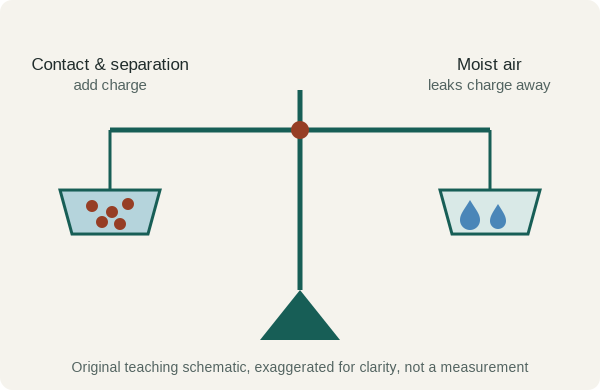
Watch a charge build and leak away
Predict, then change one thing
Try the balance: rubbing against humidity
Pick an everyday activity, then slide the indoor humidity. Predict whether the marker crosses the range where many people begin to feel a discharge before you move it.
Illustrative level: ~25 kV at 20% indoor humidity, above the range around 3 kV where many people begin to feel a discharge. Dry air: the surface water film is largely missing, so charge from each step can stay and add up.
Anchor values come from published static-control tables: carpet about 35 kV at 10-20% humidity versus 1.5 kV at 65-90%; vinyl 12 kV versus 0.25 kV; a foam chair 18 kV versus 1.5 kV. Between anchors the model interpolates on a logarithmic curve for teaching; those in-between values are illustrative, not measured. The tables come from electronics-handling references under specified conditions, and no smooth curve between sparse example values can predict the voltage of a particular person in a particular room. Treat the output as the shape of the relationship only.
Where the charge comes from
Every surface carries electrons, and different materials hold them with different grip. Press two different materials together and pull them apart, and some electrons cross over and stay. Physicists call this triboelectric charging; a shoe sole lifting off a carpet does it with every step you take.
Which material gains electrons depends on the pair. A ranking called the triboelectric series lists materials by their tendency to give up or collect electrons. Hair rubbed by a wool hat loses electrons to the wool; a rubber sole on a synthetic carpet usually collects them. The series is a guide, not a law: surface condition, moisture and contact pressure all shift the result.
One more distinction matters. Insulators such as fabric, plastic and dry skin hold charge where it lands. Conductors such as metal let it spread and escape. That is why charge lingers on you and your sweater, but not on the radiator.
What winter actually changes
Cold air cannot hold much water vapor. When winter air enters your home and the heating warms it, the amount of water in the air stays the same, but the warmer air could hold far more. The relative humidity collapses. One worked example from a university explainer: air at 57% relative humidity outdoors at -9 °C falls to about 7% when heated to 20 °C indoors, with no water removed.
Why does that matter for charge? Surfaces pull a thin, invisible film of water out of moist air, and that film conducts. In a damp room, much of the charge separated by ordinary footstep rubbing drains through this film quickly. You rarely notice the leaks because they are frequent and small. In dry winter air this escape path is much weaker. Charge from each step can then stay put and add up, until the next conductor you touch offers a way out.
So winter shocks are not caused by cold. They are caused by dry indoor air, which cold weather and heating produce together. A humidifier that raises indoor humidity attacks the real cause.
The spark, and why a key helps
Static-control references used by the electronics industry put striking numbers on this balance. Walking across a carpet can leave a person carrying tens of kilovolts at 10-20% relative humidity, against roughly 1.5 kV in a damp room at 65-90%. Vinyl floors and foam office chairs show the same pattern at lower values. These are laboratory table values under specified conditions, not promises about your hallway, but they show the scale of the humidity effect: a factor of twenty between dry and damp.
Sensitivity varies, but many people begin to feel a discharge somewhere above roughly 3 kV. The spark itself is a rapid transfer of electrons between you and a conductor at a different charge level. At these everyday levels it is brief and harmless for most people, though similar discharges can damage sensitive electronics, and a spark near fuel vapor is genuinely dangerous. The nuisance and the hazard are different situations.
For an ordinary doorknob situation, one widely shared tip is to touch the metal first with a key or coin. This does not prevent the discharge: the spark still happens, but it concentrates at the metal contact point instead of a sensitive fingertip, so it tends to sting less. It is a comfort trick for everyday metal objects, not a safety procedure for electronics, flammable atmospheres or anything fuel-related.
What the model cannot tell you
The slider interpolates between published table values on a smooth curve. Real rooms are not smooth curves. Floor materials, shoe soles, pace, clothing layers and how recently the air was humidified all move the result. Treat the output as the shape of the relationship, dry air builds charge while damp air drains it, not as a measurement of your home.
This page also says nothing about protecting electronics or working around flammable atmospheres; those have their own standards and procedures. And if a shock ever comes from a wall socket, an appliance or wiring, that is not static electricity. That is a fault for a qualified electrician.
Check your understanding
Does cold air itself cause the shocks?
No. The cause is low relative humidity, usually from heating dry winter air indoors. Warm, humid rooms let charge disperse before it builds.
Does the spark mean rubbing works harder in winter?
No. The rubbing is similar all year. In dry air less of the separated charge leaks away, so you keep more of it and reach a higher voltage.
Will touching metal first prevent the discharge?
No. The charge still leaves, but through a small metal contact point, which spreads the sensation so it stings less.
Sources & limits
- NASA Lessons Learned: static generation and typical voltages by humidity
- McGill Office for Science and Society: static shocks, humidity and heated indoor air
- Murata: static electricity basics, MIL-HDBK-773A values and the felt-shock threshold
- The Conversation, Deffner and Ibrahim: static electricity's tiny sparks
- Northeastern University: winter static and prevention
- University of Kentucky physics: surface water films and dry indoor air
Original educational explanation and graphics. The model interpolates published table values for teaching; nothing on this page was measured in your home, and it is not ESD-control, medical or electrical-safety advice.