Home energy · Illustrated explainer 04
Watts are a rate. Kilowatt-hours add up.
A number on a device and a number on an electricity bill answer different questions. See the difference before calculating a running cost.
A 1,000-watt label can look like a price tag waiting to happen. It is not. Watts describe power: how fast energy is being used at a particular moment. A kilowatt is 1,000 watts. A kilowatt-hour, usually written kWh, is an amount of energy. It connects a rate to a duration.
If a load really draws one kilowatt continuously for two hours, it uses two kilowatt-hours. The same amount of energy could come from a different constant combination of power and time. Two kilowatts for one hour also gives two kilowatt-hours. That is an arithmetic comparison, not a claim that two real appliances do the same job or use the same operating pattern.
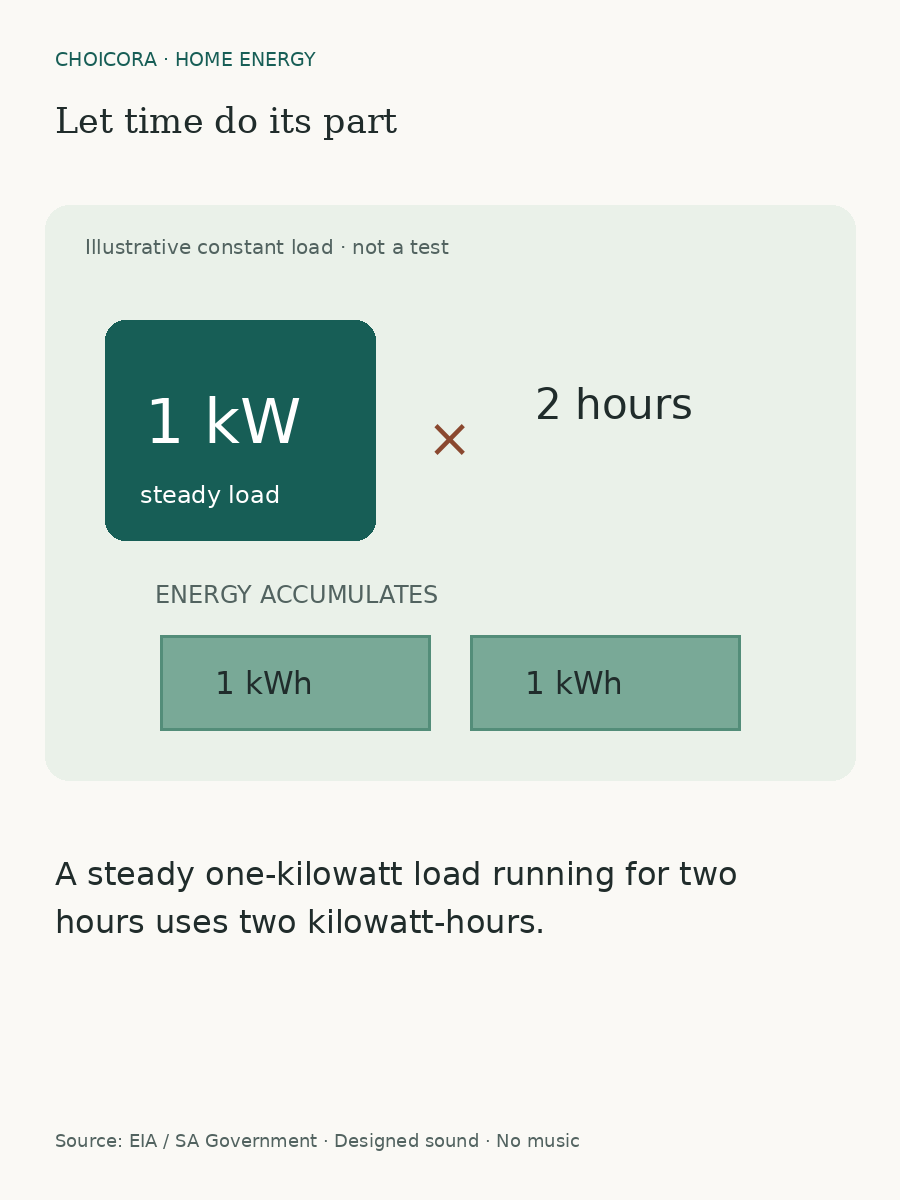
Watch the rate become an amount
Predict, then change the input
Which number do you actually have?
Choose a constant-power example or enter measured energy for one use. Your price per kWh stays yours: no national tariff or currency is assumed.
Use this only as a constant-load illustration. Nameplate watts may not be a steady draw. We do not invent a cycling percentage.
Enter a known kWh total for the exact use you want to price, such as a recorded meter result. A whole-home bill does not isolate one appliance.
Enter 0.30 for thirty hundredths of one currency unit, not 30. Copy the applicable energy unit rate, not the bill total. This example does not model tariff tiers or time-varying rates.
2 kWh of energy
1,000 W ÷ 1,000 × 2 h = 2 kWh.
Enter your own unit price to see an estimated energy charge.
Blocks are a scaled visual cue, capped at ten; the written result is the full amount. This estimates the energy charge for the stated use, not a whole bill, savings, efficiency or suitability. No value is sent or saved.
A rate is not an amount
It helps to keep three questions separate. Power asks how fast. Energy asks how much over time. Cost asks what price applies to that energy. If you jump directly from watts to money, you have skipped duration and the price per unit.
The simple relationship for a constant load is energy in kWh = watts divided by 1,000, multiplied by hours. Once you know energy, multiply kWh by your price per kWh. The result uses the same currency unit as the rate you entered. We leave that price blank rather than quietly inserting a tariff from a country you may not live in.
One kilowatt for two hours and two kilowatts for one hour have the same energy total. The rate changed and the time changed, but their product did not. This says nothing about which appliance is useful, safe or efficient.
Why the label may not match the whole session
Many appliances do not draw the same power from start to finish. Controls can change their operation, and some equipment cycles on and off. A label or manual is a starting point, but its number should not silently become a claim about the entire time an appliance is plugged in.
That is why the tool offers a separate measured-energy mode. A reliable kWh reading for a defined use already includes the changes during that measurement. You can price that total without pretending the load was constant. The measurement still belongs to its conditions: a different programme, room, load or duration can give a different result.
Do not turn this explanation into an instruction to open equipment, touch wiring or improvise electrical measurements. Any meter or appliance must be used within its own instructions and ratings. We have not performed a device test for this article.
Energy labels need their units kept intact
A power figure in watts, an energy figure per cycle and an annual energy figure are not interchangeable inputs. If a label says energy per year, that is not the energy of one use. If it says energy per 100 cycles, that is not the energy of one cycle. The test conditions and the stated basis matter as much as the number.
This page does not try to translate every energy-label scheme. Rules and test programmes vary by product and market. Use the exact label or model documentation and keep its time or cycle basis attached. Our measured-energy field asks for a kWh total for the particular use being priced, not an unexplained number copied from anywhere on the label.
Why the result is not your electricity bill
An electricity bill can contain other charges, taxes, more than one unit price and the consumption of many devices. This tool multiplies one stated energy amount by one stated rate. It does not add fixed charges, allocate a whole-home bill among devices or predict a tariff.
It also does not compare the work delivered by two devices. A lower wattage is not automatically a lower energy total for a task if the task takes longer. An energy estimate is useful when its boundaries stay visible: which use, how much energy, which rate and which charges are left out.
Check your understanding
Does a 2,000 W device always cost twice as much as a 1,000 W device?
Not for an unspecified use. At those constant draws for the same time and rate, yes, the energy charge doubles. Different times or operating patterns can change the comparison.
Can I enter the total on my electricity bill as the price per kWh?
No. The field needs a price for one kWh, not a whole-bill amount. Keep any tiered, time-varying or fixed charges outside this simple model.
Sources & limits
- U.S. Energy Information Administration: measuring electricity, watts and watt-hours
- South Australian Government: appliance input power and running-cost calculation
- DOE-hosted educational worksheet: constant-power arithmetic and label-versus-actual-draw limits (archived educational material)
- European Commission: an example of a product-specific label using kWh per 100 cycles (EU tumble dryers)
The sources come from different jurisdictions; the physical units transfer, their tariffs and local rules do not. No tariff, product recommendation, measured appliance result or saving is supplied here.