Heat & materials · Illustrated explainer 05
Same temperature. Different feeling.
A metal surface can feel colder than wood in the same room. The missing part of the comparison is how quickly heat leaves your skin.
Imagine a wooden tabletop and a metal object that have been left in the same stable room, away from direct sunlight, heaters or other heat sources. They may have settled to the same temperature. That does not mean they will feel the same when touched. Metal often feels colder.
The tempting conclusion is that the metal must have started colder. But touch is not a direct reading of an object's temperature. What happens to your skin during contact matters. A surface cooler than your skin can take energy from it. If that energy moves away quickly, your skin cools more quickly, and the surface can feel colder even when its starting temperature matches the wood.
Watch the direction before the speed
Predict, then reveal
Change the temperature relationship
Both materials start at the same temperature as each other. Change how that temperature compares with the skin at contact. Before selecting, predict which way energy will flow.
From skin into the materials
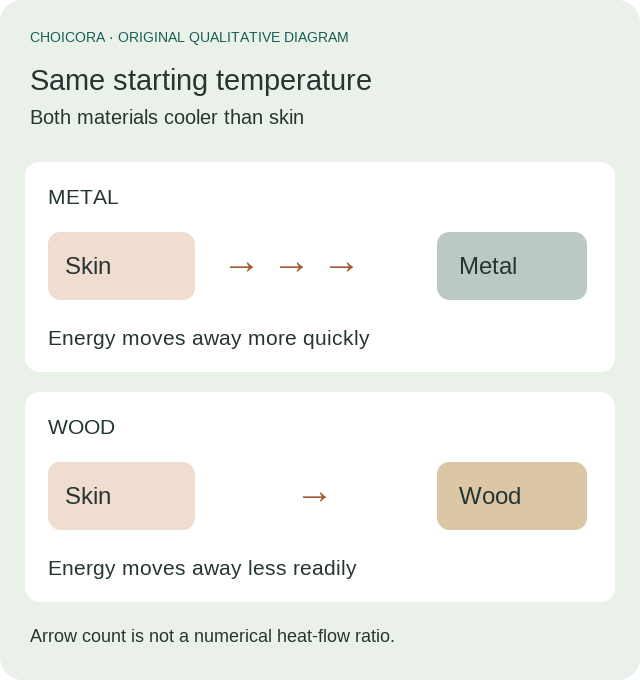
Energy flows from warmer skin toward each cooler material. Metal usually carries it away more quickly than wood, so metal can feel colder even though both started at the same temperature.
Qualitative arrows only. More arrows do not mean a measured multiplier. No temperatures, contact times, pain limits or material properties are calculated. These states are ideas to compare, not instructions to touch hot or cold objects. Nothing is sent or saved.
Temperature and heat flow answer different questions
Temperature describes a thermal state. Heat transfer is energy moving because of a temperature difference. During contact, energy moves from the warmer side toward the cooler side. If the material is cooler than your skin, the direction is from skin into material. If the material is warmer, the direction reverses.
That direction comes first. Calling metal a good conductor does not mean it always feels cold. It means energy can move through it readily. A warmer metal surface can transfer energy toward your skin quickly instead. The same material property can help explain a cold feeling in one situation and a hot feeling in another.
“Same room” is a useful setup, not proof of equal temperature. Sunlight, a nearby heater, recent handling or a different starting temperature can change the actual temperatures. Our model explicitly gives both materials the same starting temperature.
Why wood changes the contact differently
Metals generally conduct heat more readily than wood. When a cooler metal object takes energy from your skin, it can conduct that energy away from the contact region into the rest of the object. That lets the contact region keep taking energy from the skin.
Wood is a poorer conductor. Energy does not spread away from the contact region as readily, so the local surface can warm without the rest of the object warming in the same way. The heat transfer from your skin can slow. Wood can therefore feel less cold, even without a higher starting temperature.
This is a way to understand the main contrast, not a promise about every object. The object's size, shape and contact conditions matter too. A tiny object and a large slab do not have the same amount of material available to exchange energy. Surface coatings and the way contact is made can change the comparison. We do not turn the words “metal” and “wood” into exact, universal heat-transfer rates.
What the interaction leaves out
The three buttons isolate the temperature relationship. They do not simulate skin, predict a sensation for a particular person or calculate an interface temperature. The arrows do not represent particles of cold travelling out of the object. They stand for the direction of energy transfer in a simplified comparison.
In the equal-temperature state, the model shows no net heat transfer driven by a temperature difference at that moment. That is an idealized reference state. It does not say that real skin and every part of a real object remain at one unchanging temperature during contact. Nor does it predict exactly how something will feel.
In the warmer-material state, the arrows point toward skin. That state is included to correct the idea that metal is inherently cold. It is not an invitation to test heated objects. Touch cannot tell you that a surface is safe, and this page supplies no safe temperature or exposure time.
A better question than “which one is colder?”
Separate two questions: what temperature did the object start at, and how does contact change the skin's temperature? The first needs an appropriate measurement under known conditions. The second depends on the exchange of energy during contact, including how readily the material moves that energy away or supplies more.
That distinction makes the everyday puzzle useful. The metal does not need a secret source of cold. Two objects can start at the same temperature, while the contact experience differs because energy moves through them differently. A feeling gives you information, but it is not a substitute for a thermometer, a controlled comparison or a safety instruction.
Check your understanding
If the metal feels colder, must its starting temperature be lower?
No. Metal and wood can start at the same temperature. When both are cooler than skin, faster heat transfer into metal can make it feel colder.
Does a good conductor always feel cold?
No. The temperature difference sets the direction. If the material is warmer than skin, energy can flow toward skin instead.
Do three arrows mean three times as much heat?
No. The arrows are a qualitative contrast. No measured rate or numerical ratio is supplied.
Sources & limits
- Georgia State University HyperPhysics: steel, wood and the sense of temperature
- University of Illinois Physics Van: why metals feel cold or hot to the touch
- Exploratorium: equal starting temperatures and heat moving away from contact
This article explains a general physical idea. We have not measured samples, tested a product or assessed safe contact temperatures. No medical or burn-risk guidance is supplied. Do not use touch to check an unknown surface.